When God’s Promise Feels Offensive: 5 Surprising Lessons from Sarah’s Story
Sarah · 4 min read
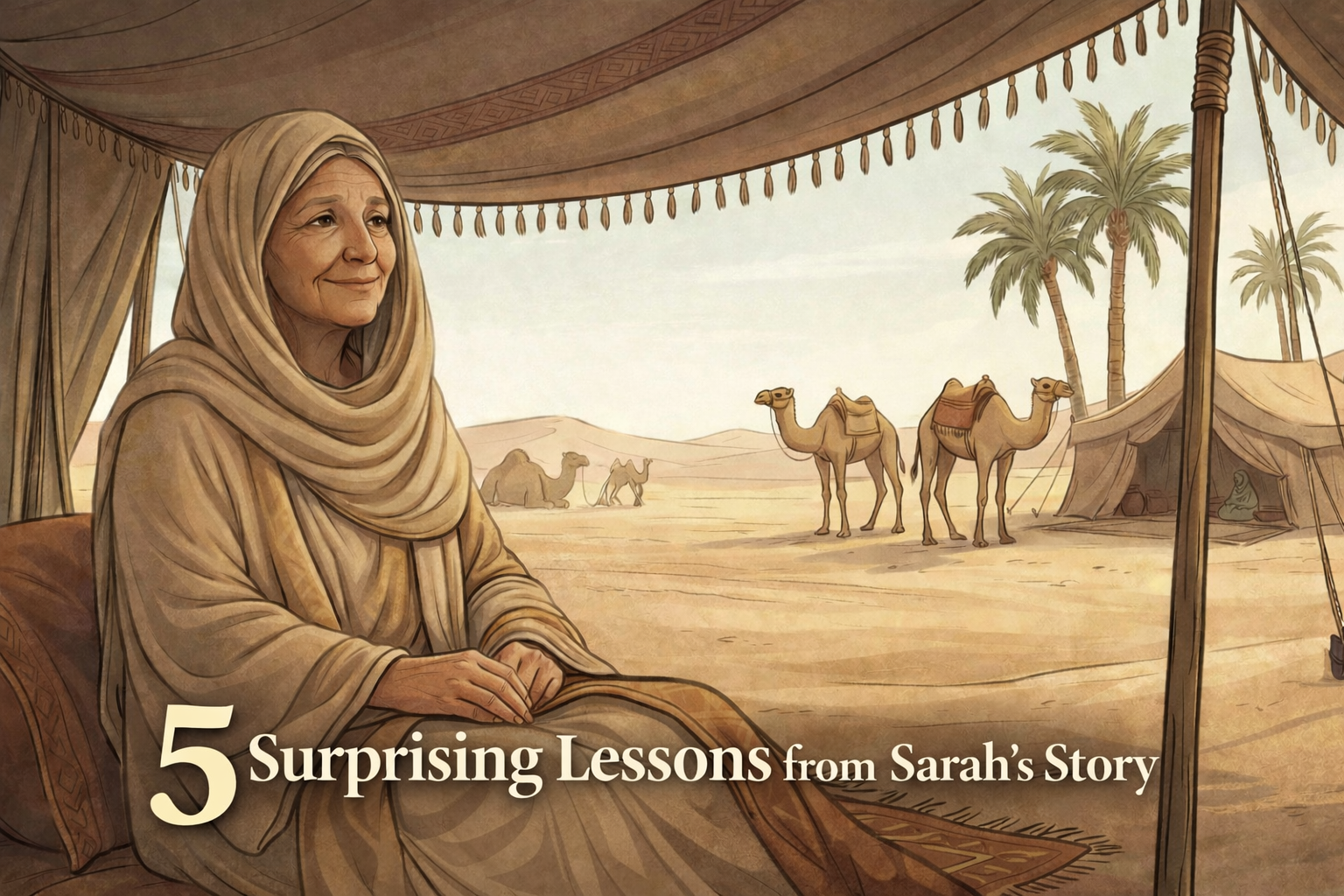
Have you ever received a promise from God that felt almost offensive? Not because the word was wrong, but because it felt too good, too impossible, or simply too late. Sarah knew that feeling. By the time God said she would hold a son, she was ninety years old, and the promise landed on an empty womb and a tired heart. Her story is a deeply human account of how God meets a woman who has waited so long she no longer expects a miracle.
Her life did not begin in the hall of faith. Genesis introduces her with one painful line: “Now Sarai was barren; she had no child” (Genesis 11:30). That was her scar, written into the very first sentence. Here are five surprising lessons from how God met her in it.
Lesson 1: Doubt often disguises itself as control
When God seems slow, many of us stop waiting and start manufacturing. In Genesis 16, Sarah reached her breaking point and tried to force the promise through her servant Hagar. Listen to how she framed it: “The LORD has prevented me from bearing children” (Genesis 16:2). She read God’s delay as God’s denial and shifted into desperate self-help. The result was a home full of conflict. Human effort cannot birth a divine promise.
Lesson 2: Faith is sometimes just surviving the delay
We expect faith to be loud and certain. Sarah’s was not, not for most of the twenty-five-year wait. Her body aged, her hope thinned, and her faith became a complicated struggle. Yet God still writes her name in the hall of faith (Hebrews 11). That tells you something freeing: God treasures the quiet endurance of showing up again when heaven seems silent. Faith is not always loud. Sometimes faith is simply surviving the delay.
Lesson 3: God is not intimidated by your cynicism
At the oaks of Mamre, Sarah overheard the Lord promise a son within the year, and she laughed behind the tent door (Genesis 18). It was not joy. It was grief and exhaustion. When God exposed her laughter, it was not to shame her but to bring her doubt into the light, because God does not heal what we hide. Then He asked the question that still confronts every skeptic:
“Is anything too hard for the LORD?” (Genesis 18:14)
For medicine, money, and time, some things are. For the God who made the womb, the word impossible does not exist.
Lesson 4: His faithfulness is tied to His promise, not your performance
When the miracle arrived, Genesis is careful about why. “The LORD did to Sarah as He had promised” (Genesis 21:1). The fulfillment rested on God’s character, not Sarah’s flawless behavior. Hebrews 11:11 says she received power because she came to “consider Him faithful who had promised.” God does not erase the messy parts of our story. He redeems them. He took a woman who laughed in disbelief and set her among the faithful.
Lesson 5: God redeems the laugh
There is holy irony in her son’s name. They called him Isaac, which means “he laughs.” God took the very sound of Sarah’s cynicism and turned it into a lifelong testimony of joy.
“God has made laughter for me; everyone who hears will laugh over me.” (Genesis 21:6)
He did not only fulfill the promise. He redeemed the memory of the delay, turning a laugh of pain into a laugh of praise.
A prayer for the tired heart
Father, I am tired of waiting, and sometimes my laugh is exhaustion, not joy. Thank You that You are not offended by my honesty and not limited by my circumstances. Do in my life what only You can do, and turn my impossible into an Isaac. I trust You, and I ask this in the name of Jesus. Amen.
Questions people ask about Sarah’s story
Why did Sarah laugh at God’s promise?
Her laugh was the reflex of a woman disappointed for decades (Genesis 18:12). It was grief and cynicism, not rebellion, and God met it with a question rather than a rebuke.
Did Sarah’s doubt disqualify her from God’s promise?
No. God kept His word “as He had promised” (Genesis 21:1), and Hebrews 11 lists her among the faithful. His faithfulness rested on His character, not her perfect certainty.
If your heart is laughing out of exhaustion today, God is still at work behind the tent door. Keep going with Sarah and Waiting: Trusting God When Time Feels Like the Enemy, or explore the Women of the Bible book on Amazon.
Keep reading