
The short version
Ten women in the Bible show what happens when love is unequal, delayed, or absent. Leah stops performing. Abigail acts wisely inside a foolish marriage. Michal shows how contempt kills a marriage before a fight ever does. The woman at the well learns that no person can be a source. Each story ends with one usable decision, not a rule.
Ask most people what the Bible says about relationships and they will quote a wedding verse. But the women of the Bible are almost never in wedding scenes. They are in the difficult middle: married to men who will not see them, waiting on promises that keep not arriving, negotiating from positions with very little power.
That is exactly why their stories are useful. They were not written to describe a happy relationship. They were written to describe what a woman does when the relationship is not what she was promised.
Here are ten of them, what each one learned, and what that decision looks like in an ordinary week. If you would rather take these one morning at a time, they also live in the daily devotionals.
Why the women of the Bible say so little, and why it matters
Women speak roughly 1.1 percent of the words in the Bible. Reverend Lindsay Hardin Freeman and a research team spent three years counting: 93 women have speaking parts, only 49 of them are named, and together they say about 14,056 words out of more than a million. Every recorded sentence is doing a great deal of work.
Worth adding: this is not a niche interest. Pew Research Center’s 2023 to 2024 Religious Landscape Study found that 50 percent of women in the United States pray daily, compared with 37 percent of men. The women in these ten stories are being read, closely, by a lot of people who are looking for something they can use.

Lesson 1: You cannot earn a love that has already decided (Leah)
Leah had four sons trying to make her husband see her, and the names she gave them are the record of it. Genesis 29 tells us Jacob loved her sister Rachel. Leah’s father sent Leah into the marriage instead. There is not one recorded word of affection from Jacob to her in the entire account.
Watch the naming. Reuben: “Surely my husband will love me now.” Simeon: “Because the Lord heard that I am not loved.” Levi: “Now at last my husband will become attached to me.” Three children, three attempts, each one handed over like a receipt.
Then comes a fourth son, and something has changed. She names him Judah and says, “This time I will praise the Lord.” Notice what is missing from that sentence. Her husband is not in it. For the first time she names a child without mentioning him at all.
There is a longer devotional on Leah if this is the one you needed. And the line of Judah becomes the line of David, and then of Jesus. The promise does not travel through the sister who was wanted. It travels through the one who stopped begging.
Lesson 2: His foolishness is not your assignment, but your wisdom is (Abigail)
Abigail was married to a man scripture calls a fool, and she is the only reason anyone in that household survived. In 1 Samuel 25, her husband Nabal insults David, and 400 armed men start walking toward the property. Abigail’s own summary of her husband is blunt: his name means fool, and folly goes with him.
Here is what she does not do. She does not try one more time to explain to Nabal why he was wrong. She does not wait to see whether he will come around. She loads 200 loaves of bread, wine, roasted grain, raisins and figs, and she rides out to meet 400 swords herself.
Then she talks a future king out of murder, and she does it without trashing her husband for sympathy. She tells David that when God has done everything he promised, he will not want needless bloodshed on his conscience. She is protecting David’s future, not Nabal’s pride.
And then she goes home. Nabal is drunk at a feast, so she says nothing. She waits until morning, when he is sober, and tells him what she did.
Lesson 3: Contempt is what ends a relationship, not conflict (Michal)
The Bible records the moment a marriage died, and it was a look out of a window. In 2 Samuel 6, David is dancing in the street as the ark comes into the city. One verse interrupts the celebration: Michal watched from a window, and when she saw him, she despised him in her heart.
She had not said anything yet. Nobody in that street knew. He is worshiping, she is at a window, and something is already over.
Modern research lands in the same place. The Gottman Institute, drawing on four decades of John Gottman’s research on couples, names contempt the number one predictor of divorce among its four horsemen. Not conflict. Contempt.
The distinction matters. Conflict is two people facing a problem. Contempt is one person looking down at the other. And contempt does not begin with a scene. It begins at a window, with an eye roll nobody sees, with the version of him you narrate to your sister.
One clarification, because this gets misused. Seeing plainly that someone is treating you badly is not contempt. Naming harm is not contempt. Contempt is the point at which you no longer want him to be well.

Lesson 4: He can love you and still not understand you (Hannah)
Hannah’s husband was not the villain of her story, and that is what makes it useful. 1 Samuel 1 says Elkanah loved her and gave her a double portion. He was neither cruel nor absent. And when he found her weeping, he said, “Don’t I mean more to you than ten sons?”
He meant it kindly. It was still the wrong thing, because it made her grief about him.
What Hannah does next is the lesson. She does not argue. She does not spend the next decade teaching him to comfort her correctly. She does not conclude that because he cannot understand, he does not love her. She goes to the house of the Lord and prays so hard that the priest assumes she is drunk. “I was pouring out my soul to the Lord,” she tells him.
Then the detail that carries the whole chapter: she went back, and she ate, and her face was no longer downcast. Nothing in her circumstances had changed. Something had been set down.
Lesson 5: What you build out of impatience, you live inside afterward (Sarah and Hagar)
Genesis 16 records a decision made at the very end of a woman’s patience. Sarai had waited ten years in Canaan for a promised child. She says, “The Lord has kept me from having children. Go, sleep with my slave. Perhaps I can build a family through her.”
Perhaps I can build. That is the sound of someone deciding to help God along. The ten years of waiting that came before that sentence get their own study in Sarah and Waiting.
It works, briefly. Hagar conceives. Then read what follows. Hagar looks at Sarai differently. Sarai turns bitter. Abram declines to lead. A pregnant woman ends up running into the desert alone. Thousands of years later, the consequences are still being litigated.
There are two women here, and God loses track of neither. Out in that desert, alone and used, Hagar becomes the first person in all of scripture to give God a name. She calls him El Roi, the God who sees me. The angel’s question to her is worth sitting with: where have you come from, and where are you going? That is a question you ask someone whose story is not finished.
Lesson 6: No person is a well (the woman at the well)
John 4 begins with a scheduling detail that tells you everything. A woman comes to the well at the sixth hour, which is noon, the hottest part of the day. Women drew water in the morning, together. It was the social hour of the village. A woman arriving alone at midday has organized her entire day around not running into anybody.
Jesus asks her for a drink. Eventually he tells her to call her husband. She says she has none. He answers that she is right, because she has had five husbands, and the man she is with now is not her husband.
That verse is often preached as an accusation. Read the scene again. It is closer to the first time somebody said the true thing out loud and did not leave. That difference is the whole subject of condemnation versus conviction at the well.
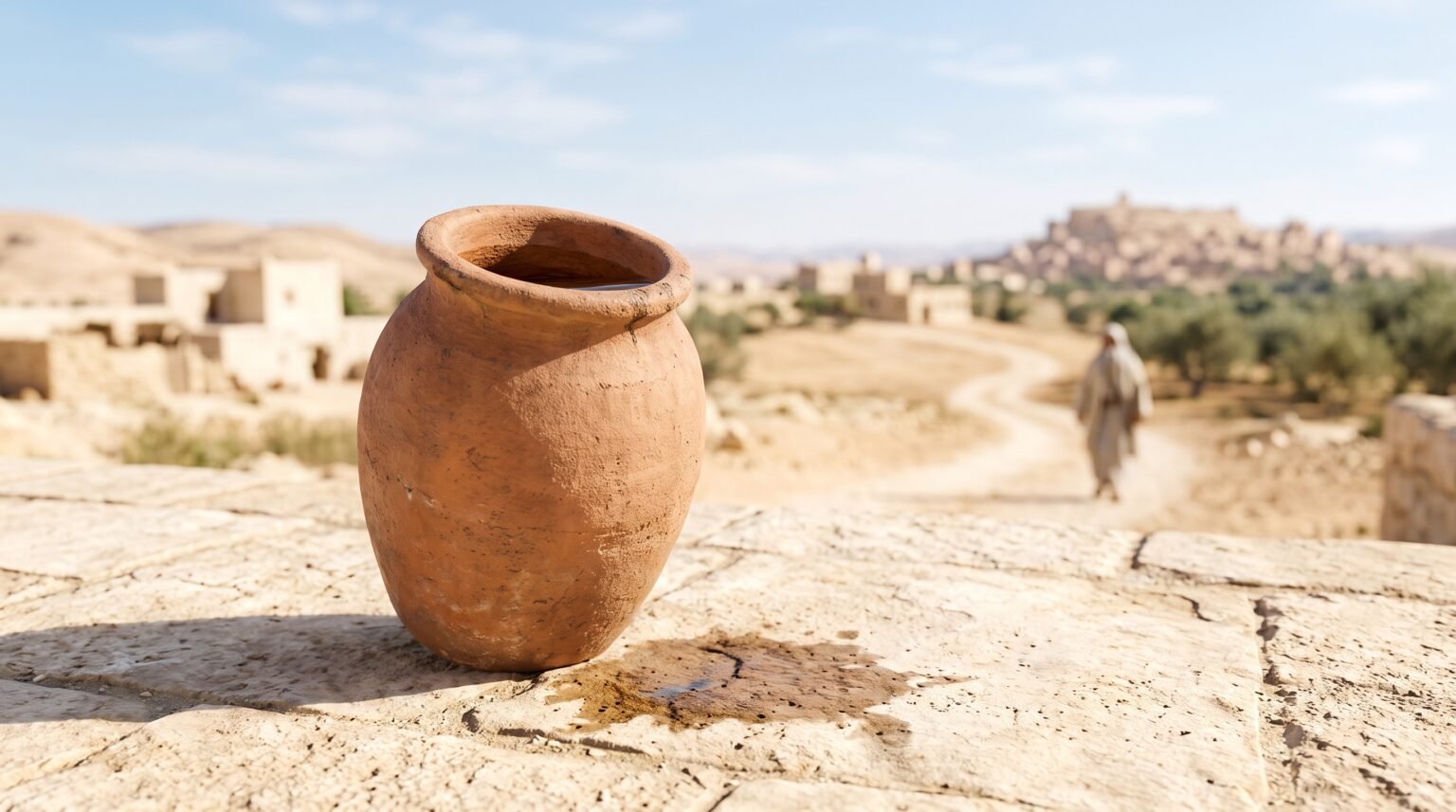
Consider what is buried in the number five. Five times she thought, this one. Five times someone was going to be the thing that finally filled her. Five times she walked back out to that well with the same empty jar.
Everyone who drinks this water will be thirsty again.John 4:13
He is standing at a well telling a woman that the well is not the problem. The problem is that she keeps going to wells. And the last beat of the story is one clause long: she left her water jar. She came for water, forgot the jar, and walked back into the town she had been avoiding at noon.
Lesson 7: You can win the blessing and lose the relationship (Rebekah)
This one is about a mother, and it has the saddest ending in the list. In Genesis 27, Rebekah engineers a deception in detail: her son dressed in his brother’s clothing, goatskins on his arms so he feels hairy, the meal cooked to taste right. “Let the curse fall on me,” she tells Jacob. “Just do what I say.”
Here is the part that should unsettle us. Rebekah was not wrong about the outcome. God had told her before the boys were born that the older would serve the younger. She had the promise straight from God. She was right about the destination and catastrophically wrong about the route.
Esau vows to kill his brother. Rebekah sends Jacob away and tells him to stay with her brother a few days, until the fury subsides. He is gone twenty years. Scripture never records them meeting again. She never met his wives or held his children. The next mention of Rebekah is where she was buried. Read it next to the audacity of her yes as a young woman and the ending lands harder.
Lesson 8: A boundary and a strategy are different skills (Vashti and Esther)
Two queens, one palace, one king, two kinds of courage. In Esther 1, King Xerxes is seven days into a feast and sends for Queen Vashti to display her beauty to the men. She refuses. Scripture gives her no speech and no explanation. She simply will not come, and it costs her the crown.
People have argued about Vashti for centuries. Say it plainly: a woman declining to be displayed for a room of drunk men is not pride. That is a boundary, and boundaries sometimes cost exactly that much.
Then Esther, in the same palace, facing worse, because an entire people are scheduled to be killed. She does something different. She fasts three days. She approaches the king uninvited, which carried a death sentence. He asks what she wants and she does not tell him. She invites him to dinner. At dinner he asks again, and she invites him to a second dinner.
Read that as competence, not fear. She knows precisely how long this man takes to become able to hear something true, and she waits until the room is right. Then she speaks, and a nation lives.

Lesson 9: Character is what he does when he could take advantage and does not (Ruth and Boaz)
Ruth 3 is the standard, and it deserves to be read as a measuring stick rather than a romance. Ruth is a widow, a foreigner, and poor, which in that world is close to unprotected. Naomi sends her to the threshing floor at night, after Boaz has eaten and had something to drink, to lie down at his feet.
Be honest about the scene. It is midnight. He is alone. She has no family standing behind her and nobody who would come looking. Nothing at all stands between him and taking whatever he wants.
He wakes up startled, and the first words out of his mouth are a blessing: “The Lord bless you, my daughter.” Then he tells her a nearer relative has a prior claim and that he will settle it properly in the morning, at the gate, in front of witnesses.
Then the line that settles the question of his character. He tells her to leave before it is light enough for anyone to recognize her, because no one must know a woman came to the threshing floor. He protected her reputation ahead of his own. And he sends her home with six measures of barley so she does not walk back empty-handed and give anyone something to say.
Lesson 10: This is what it looks like when it works (Priscilla)
Priscilla and Aquila made tents, and the whole lesson is in a detail most readers skip. They appear six times in the New Testament, across four books, written by two different authors, and they are never mentioned separately. Not once.
They worked the same trade in the same shop. The church met in their house. Paul stayed with them and worked alongside them. When a gifted young preacher named Apollos was teaching something not quite right, Acts 18 says they invited him home and explained the way of God more adequately. Both of them. Privately, so he would not be humiliated in public.
And in four of those six mentions, her name is listed first, in a first-century document. That is not an accident.
There is no betrayal in their story, no rivalry, no scheme. That is precisely why it belongs on this list. If nine painful stories have convinced you the tenth is not real, notice that it is in the Bible too. It is simply quieter, and quiet does not travel as far.

Watch the full version
All ten of these are told at length in a 40-minute devotional on the Living Word Cafe channel, with the stories read slowly rather than summarized. The chapter list matches the ten sections above.
The ten lessons at a glance
| Woman | Passage | The lesson |
|---|---|---|
| Leah | Genesis 29 to 30 | You cannot earn a love that has already decided |
| Abigail | 1 Samuel 25 | His foolishness is not your assignment; your wisdom is |
| Michal | 2 Samuel 6 | Contempt ends relationships, conflict does not |
| Hannah | 1 Samuel 1 | He can love you and still not understand you |
| Sarah and Hagar | Genesis 16 | What you build out of impatience, you live inside afterward |
| The woman at the well | John 4 | No person is a well |
| Rebekah | Genesis 27 | You can win the blessing and lose the relationship |
| Vashti and Esther | Esther 1 and 4 | A boundary and a strategy are different skills |
| Ruth and Boaz | Ruth 3 | Character is what he does when he could and does not |
| Priscilla | Acts 18, Romans 16 | Partnership is quiet, and it is real |
Each of these ten women of the Bible has more in her story than one section can hold. The longer studies are gathered in Women of the Bible.
How to use these ten lessons this week
Reading about the women of the Bible changes nothing by itself. Every one of these women moved the same way, and none of them started with a plan. They started with one honest sentence. Here is the smallest useful version of that.
1. Pick the one that found you
One of the ten probably landed harder than the rest. That is the only one to work with. Do not try to apply all ten, because a list you apply evenly is a list you apply to nobody.
2. Ask the diagnostic question
Not what he should do. Not what she should have done. This one: what is the one thing I keep doing that I already know is not working? Name it once, out loud if you can.
3. Say the honest sentence to God before you say anything to anyone else
Leah said, this time I will praise the Lord. Hannah said, I was pouring out my soul. Hagar said, you are the God who sees me. None of those sentences fixed the circumstances. Each one changed the woman who said it.
4. Take one action that is yours alone
Abigail loaded a cart. The woman at the well left a jar. Choose something that does not require another person’s cooperation, because a step that depends on him changing is not a step.
5. Guard the thing everything else flows from
Above all else, guard your heart, for everything you do flows from it.Proverbs 4:23
The work is not out there in him, or her, or the relationship. The work is the thing you are guarding. That is the whole reason these ten stories were written down.
Want to keep going with this?
There is a free 7-day devotional written for exactly this: quiet, short, one page a morning. Get the 7-day devotional here.
Frequently asked questions
Which women in the Bible teach the most about relationships?
Leah, Abigail, Michal, Hannah, Hagar, the woman at the well, Rebekah, Vashti, Esther, Ruth and Priscilla carry the clearest relational lessons. Their stories cover unequal marriage, contempt, grief a spouse cannot hold, impatience, misplaced dependence, manipulation, boundaries, male character, and healthy partnership.
What does the Bible say about a difficult or unequal marriage?
Scripture does not pretend these marriages away. Abigail in 1 Samuel 25 is married to a man the text calls a fool, and she acts wisely without waiting for him to change. Leah in Genesis 29 stops trying to earn affection. Neither woman is told to perform harder.
Is setting boundaries biblical?
Esther 1 records Vashti refusing an order to display herself before drunk men, with no explanation given. Esther 4 shows a different approach: fasting, timing, and a carefully chosen moment. Scripture presents both as forms of courage, which suggests boundaries and strategy are separate, legitimate skills.
What does the woman at the well teach about relationships?
John 4 shows a woman with five former husbands still walking to a well alone at noon. Jesus tells her that everyone who drinks this water will be thirsty again. The lesson is that no relationship can function as a source, and expecting one to will exhaust both people.
Why is Boaz considered the standard for godly men?
In Ruth 3 he has power, opportunity and total privacy at midnight with an unprotected woman. He blesses her, insists on settling the matter publicly at the gate, protects her reputation before his own, and sends her home with six measures of barley so she is not seen returning empty-handed.
What does Proverbs 4:23 mean for relationships?
“Above all else, guard your heart, for everything you do flows from it.” Applied relationally, it moves the work from the other person to your own interior life: what you tolerate, what you feed, and what you allow to curdle into contempt before anyone has said a word.
About the author. Esther Jameson writes daily devotionals and Bible studies for Living Word Cafe, where she has spent the last several years working through the narratives of women in scripture verse by verse for a devotional audience of women in the middle of hard seasons. Every passage in this article was read in context before it was written about, and every statistic is sourced below.
Sources
- Lindsay Hardin Freeman, Bible Women: All Their Words and Why They Matter. Word counts reported in Religion News Service, “Women: Just 1% of the Bible,” November 25, 2014, and Christian Feminism Today, “How Many Words Are Spoken By Women In The Bible?”
- The Gottman Institute, “What is Contempt? Understand one of the Gottman four horsemen”, on the four horsemen and four decades of John Gottman’s couples research.
- Pew Research Center, 2023 to 2024 Religious Landscape Study, “Prayer and other religious practices,” published February 26, 2025.
- Scripture quotations are from the New International Version.