Is Anything Too Hard? 5 Surprising Ways Sarah’s Faith Beats Modern Doubt
Sarah · 4 min read
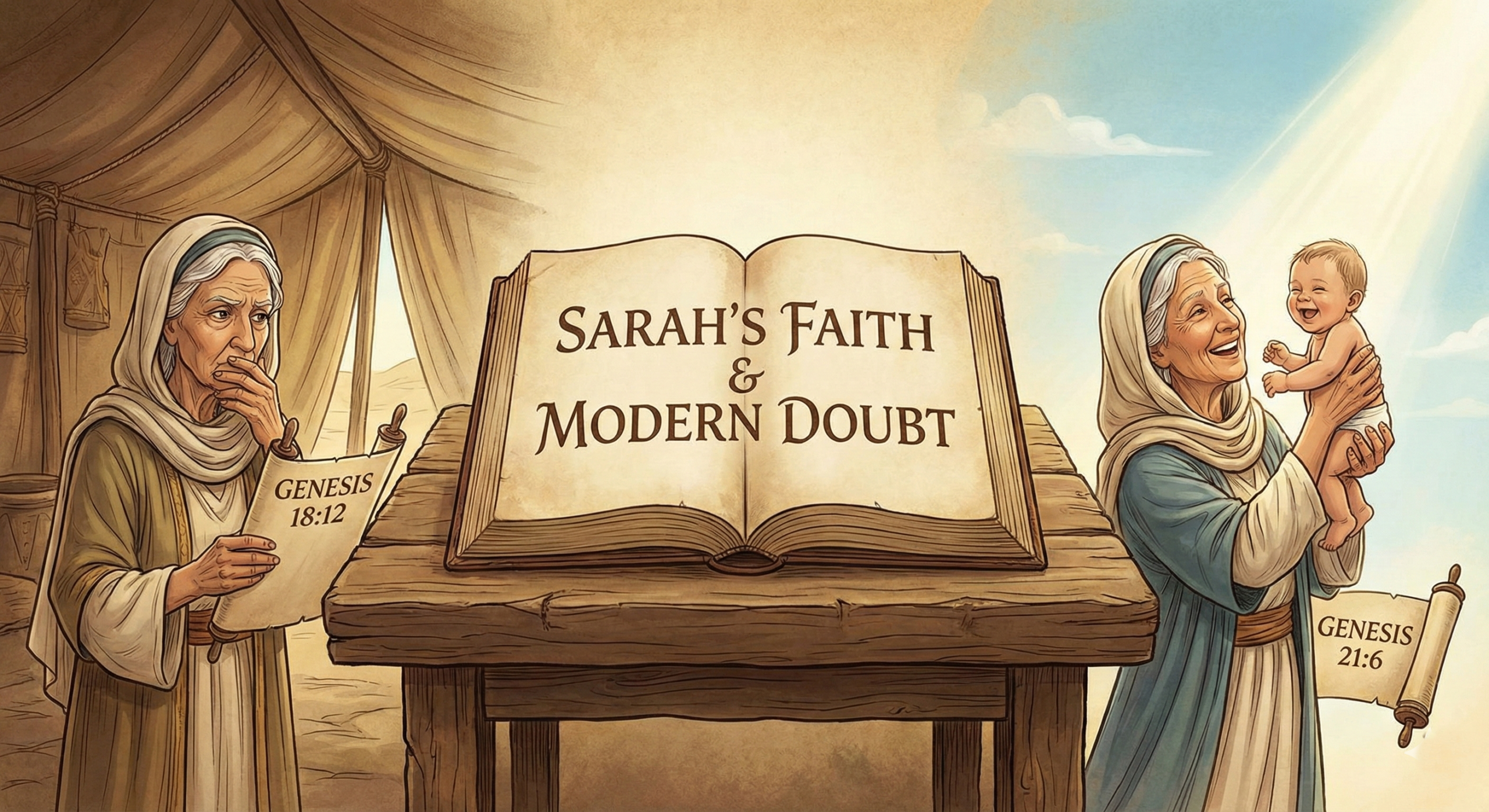
Modern doubt usually sounds like the calendar. If the breakthrough has not come by a certain age or stage, we assume the expiration date on God’s power has passed. Sarah faced the ultimate “too late,” and her story still ended in laughter. Here are five ways her faith answers the doubt we carry today.
1. The “too late” fallacy
Sarah was ninety when the final promise of a son came, and Abraham was one hundred (Genesis 17:17). Genesis refuses to soften the biology: “Abraham and Sarah were old and well advanced in years, and Sarah was past the age of childbearing” (Genesis 18:11). And yet, “Sarah conceived and bore Abraham a son in his old age, at the time God had promised” (Genesis 21:2). God did not ignore her age. He simply was not restricted by it. “Too late” is a human fallacy, not a divine limit.
2. Honest skepticism did not disqualify her
We often assume faith must be flawless certainty. Sarah’s was grittier than that. Hearing the promise, she “laughed to herself” (Genesis 18:12), the private reflex of a heart guarded by years of disappointment. When fear made her deny it, God answered with startling honesty: “Yes, you did laugh” (Genesis 18:15). He was not offended by her limits. In the middle of her doubt He gave her the anchor of her whole life: “Is anything too hard for the LORD?” (Genesis 18:14).
3. Stop trying to help God out
When the timeline stalls, our instinct is to hustle. Sarah waited ten years in Canaan before she tried to build a family through Hagar (Genesis 16:3). Her patience was not thin, it was simply exhausted. The plan produced immediate misery and a broken household (Genesis 16:4-6). When we try to manufacture a promise through our own manipulation, we usually create more pain than the waiting ever did. Sarah’s faith was rebuilt after her own plans failed, not because they succeeded.
4. God renamed her before the miracle
One of the most powerful moments came before any pregnancy. Just as Abram became Abraham, Sarai became Sarah, “princess,” a mother of nations (Genesis 17:15-16). At that moment she was still ninety and still childless. God defines identity by His promise, not by present circumstances. Doubt is often an identity crisis, and Sarah’s story insists that God sees the queen even when the woman in the tent feels like a failure.
5. The final laugh
Two kinds of laughter frame Sarah’s life: the laugh of the skeptic (Genesis 18:12) and the laugh of the mother. God Himself chose the child’s name, Isaac, “he laughs” (Genesis 17:19), a permanent memorial to His power over impossibility. The cynicism that once guarded her heart gave way to joy so full it needed witnesses:
“God has brought me laughter, and everyone who hears about this will laugh with me.” (Genesis 21:6)
A prayer when doubt sounds reasonable
Lord, my doubts feel so logical, and the clock feels like my enemy. Remind me that nothing is too hard for You. Rebuild my faith where my own plans have failed, and let me see the identity You have already spoken over me. I put my trust in You, in the name of Jesus. Amen.
Questions people ask about faith and doubt
Is it wrong to doubt God’s promises?
Doubt is not the same as unbelief. Sarah doubted and still ended among the faithful (Hebrews 11). Bring your honest questions to God, as she did, and let Him answer them.
What does “Is anything too hard for the LORD?” mean for me?
It reframes your situation around God’s power instead of your limits (Genesis 18:14). The question is not whether your problem is big, but whether your God is bigger.
If the calendar has been preaching doubt to you, let Sarah preach back. Keep reading with When God’s Promise Feels Offensive, or explore the Women of the Bible book on Amazon.
Keep reading